Learning how eyes work
Another lesson on our five human senses focused on understanding how the eyes function. Teaching my daughter about how eyes work was a fun learning experience about a complex body system. Understanding the basics of vision not only satisfied curiosity but also helped her learn about optics and color science. The human eye is a remarkable organ, enabling us to perceive the world around us with clarity and detail.
Pupil and iris
We started with learning about the pupil and the iris. The pupil is the black dot at the eye’s center and is surrounded by the colored part known as the iris. The iris, a ring of colored muscles, plays a crucial role in regulating the size of the pupil. Adjusting pupil size allows the iris to control the amount of light entering the eye, so that vision can be maintained despite how dim or bright the environment is.
To aid my daughter in understanding how the pupil functions, I crafted a model illustrating a small pupil when light is bright and a large pupil when it is dark. Please see the link to the template Iris and Pupil Eye Model.
Eye structure
Moving on to the structure of the eye, we delved into how our eyes perceive images. The process involves the sensing and processing of light by our eyes.
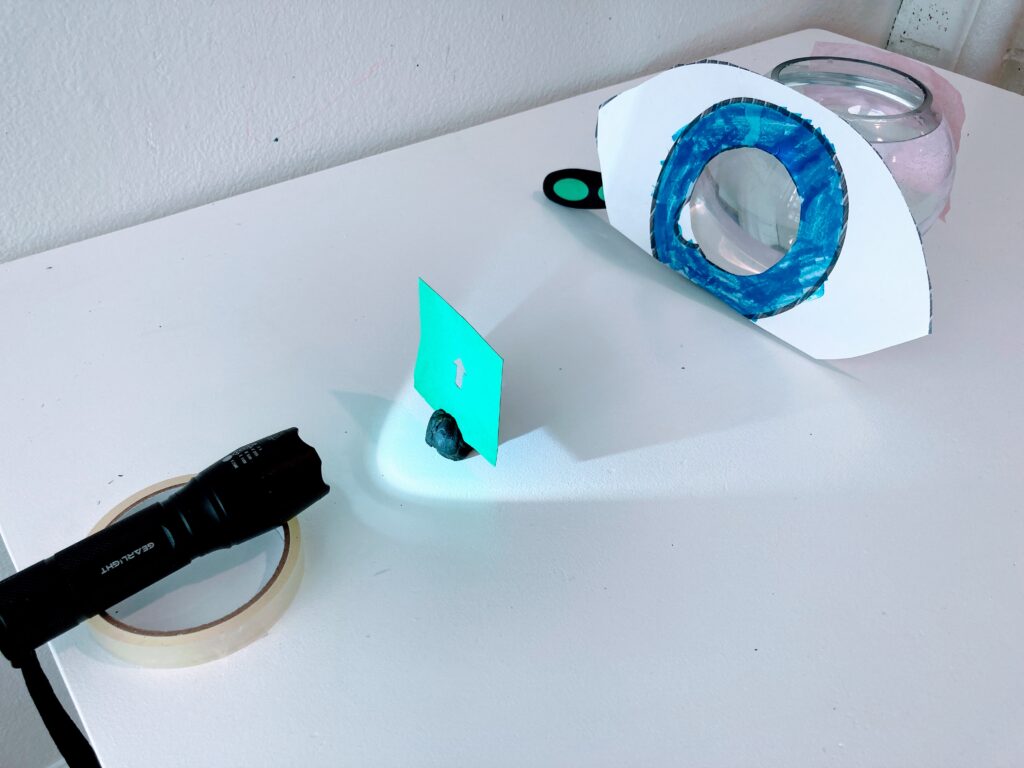
We attempted to replicate the structure of an eye using a picture of an iris, a lens, a small fishbowl, and a flashlight. The idea was that the hole in the picture (a pupil) lets the light inside of an eye, then it goes through a magnifying glass (a lens) which autofocuses it onto the retina (in our case the pink tissue paper) at the back of the eye. One objective was to see how the image formed on the retina appears upside down. After some adjustments with the light and the lens, and the placement of a mirror (to help to see what is showing on the tissue paper) behind the fishbowl, we successfully observed the inverted image.
Here is the link to the instructions from the YouTube Video “How the Eye Works”. Another video titled “Easy science experiment to show how the eye works” demonstrates the upside down image on the retina. It is more simple to replicate but doesn’t have all the elements of an eye structure.
Forming an image
I came across this excellent video that aids in understanding how cones and rods function to create an image. Rods are responsible for detecting light (gray scale) and shapes, whereas cones enable us to perceive colors.
There are three types of cones, each specialized in detecting either red, green, or blue (RGB) light. The combination of signals from these three types of cones allows the brain to perceive a broad spectrum of colors through additive color mixing. The website “Play with color and light” features an excellent tool for learning and experimenting with these three colors to create different combinations (you can change an object, color position, and intensity).
A couple of years ago, I taught my daughter that there are three primary colors: red, blue, and yellow. This concept differed from the RGB color system and caused a bit of confusion. This article clarifies that there are two color systems: Additive and Subtractive. I didn’t delve into a detailed explanation of these systems with my 5-year-old. At this point, I highlighted that we use two color approaches—one for light and another for painting. When you mix all your paints, you get a dark color, unlike when you overlap lights of different colors, which produces white light.
We took a more in-depth dive into the use of RGB colors. I used this concept to teach my daughter that if we were to closely examine the computer screen or TV, we would see dots of three colors: Red, Blue, and Green, just like the colors in the retina. Our brain blends these dots to form a picture. We conducted a series of science experiments with colorful lights from our Kiwi Co. box.
The Brain
The brain plays a crucial role in processing visual information received from the eyes. It interprets signals from the retina, creating the images we perceive, enabling us to make sense of our surroundings. Having two eyes allows us to see objects from different angles, and the brain aids in combining these images.
It was also fun to look at optical illusions, images that trick the brain. Here are a couple of websites featuring optical illusions: “Optical Illusions For Kids” and “Optical Illusions and How They Work”.
We also discussed the functions of eyelids, eyelashes, and tear ducts. Eyelashes serve as a protective shield, guarding our eyes against potential intruders such as dust, tiny bugs, or airborne particles. Additionally, blinking plays a crucial role in maintaining the moisture and cleanliness of our eyes.